
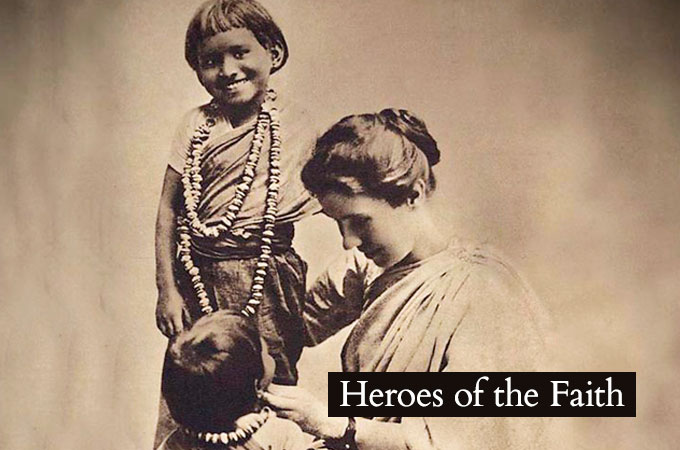
Once dubbed ‘Missionary Unpredictable’, Irish girl Amy Carmichael fought religion and risked her life, while refusing to appeal for money as she rescued hundreds of children from slavery in India.
The little girl knelt beside her bed to pray. She was only three years old, but her mother had taught her that God answers prayer. Encouraged by such a truth, she prayed that night that God would make her ‘brown eyes blue’.
In the morning she woke and rushed to the mirror, only to discover that God had not answered her prayer, for looking back at her were those same brown eyes.
Years later, Amy Carmichael would find herself in India seeking to penetrate a difficult culture and a terrible secret. Often she would disguise herself, wearing the dress of the day, rubbing coffee powder into her skin to darken it and mixing with ordinary folk in the markets and the temple. It was on seeing her daring plan and unusual tactics that one of her friends commented: “It is a very fortunate thing that your eyes are brown and not blue. You would never pass for an Indian woman then!” God never makes mistakes.
Amy was born on December 16, 1867 in Millisle, Co Down, Northern Ireland. She was the oldest of seven children and her family was of Covenanter stock – they took the things of God seriously.
She gave her life to Christ in 1883 and three years later went to Glasgow where she attended meetings similar to that of the Keswick Convention, where her heart was stirred and challenged to service for God.
She began by reaching out to those around her. She started a programme for the girls who worked in the mills and although extremely successful, it wasn’t popular with everyone – especially the religious.
Encouraged by her successes and, in some ways stirred by the opposition, Amydetermined to touch as many people around her with the love of Christ as possible.
And so she set up ‘The Welcome’, a meeting place in Belfast for the express purpose of sharing the gospel with the needy. With its pioneering element and the fact that she had to trust God for the funds needed, this adventure was to prove a training ground for things to come.
Then in January 1892, she offered her life for further missionary service, knowing God had something he wanted her to do. And the following March she sailed for Japan as the first missionary sent out by the Keswick Convention.
However, although God blessed, and many good things happened, Amy was forced out of Japan due to illness, eventually coming back to England the following year. Many, and perhaps even Amy, may have seen this as a failure, but it is amazing how often one door is closed, only for another to open.

Amy wouldn’t give up, and in November 1895 she landed in India where she remained until her death some 55 years later. But it was an event that took place a few years after her arrival in the Subcontinent which was to truly define her God-given destiny.
On March 6, 1901 a seven-year-old girl called Preena entered the mission station and begged for help. She had run away from the nearby temple where she had been sold by her parents for ‘service’ but where she did not want to stay. Having already attempted once before to run away to her home, some 20 miles away, she had been returned and subjected to the punishment of being tied to a stone and having her hands branded with hot irons. Amy was thus to uncover one of the ugliest hidden sores of Mother India’s body – the secret traffic of temple boys and girls.
Infuriated at what Satan was doing to these lovely children, Amy declared war – fighting many battles on her knees, risking her life on more than one occasion and facing arrest and imprisonment in order to snatch some pleading child from the jaws of defilement and destruction.
Not everyone believed Amy and many did not agree with her ‘undercover’ andsometimes questionable tactics (it is said she bought a child for 100 rupees). Some even suggested that if she engaged in such work, she couldn’t really be a missionary anymore.
But Amy said, “We are committed to things that we must not expect everyone to understand.” One by one, girls somehow found their way to ‘Amma’ (the Tamil word for mother) and she courageously protected them. By 1904 there were 17 children under her care… and babies and boys were to follow. In response to the growing need, Amy looked for a place where they could live in safety and peace. She found a village in South India called Dohnavur and bought a house there.
Amy was to uncover one of the ugliest sores of Mother India – the secret traffic of temple boys and girls. Infuriated at what Satan was doing to these lovely children, Amy declared war…
Visitors later began to recognise Amy’s uniqueness and the wonderful thing God was doing there. A Keswick speaker, Dr Inwood, recorded: “The two days spent there have no parallel in my experience. Everything in this work has the touch of God so naturally upon it that I lived in one unbroken act of wonder, worship and adoration.”
Even people outside Christian circles were beginning to appreciate what was being done for India. In January 1919 Amy received a telegram from the Governor of Madras congratulating her because she had been included on the Royal Birthday Honours List. Her award was the ‘Kaisar-i- Hind Medal’. After just 25 years of service, Amy and her work was now well known both in India and beyond.
At one point there were some 700 people under her care. With no appeals for cash and refusing to sponsor children individually, preferring the money to go to a central fund for all, Amy’s philosophy was simple: “It is enough to ask the Father only for money for his work.” Being so active, Amy was dubbed ‘the Hare’ but in September 1931 she had an accident which left her housebound.
However, another project was to begin. She put the work of 37 years to paper and from her room, called the ‘Room of Peace’, wrote many wonderful and inspiring books, some of which are still available today. And so in the last 20 years of her life she wrote some 35 books that have since inspired others to ‘dare as she dared’.
Warren Wiersbe, in his book ‘Great Christians You Should Know’, called her ‘Missionary Unpredictable’. Many churches and mission societies today may well struggle with Amy’s unorthodox ways. But she reached the lost and dying with the love of God; she made her life count and left a legacy that is still with us.
Amma Amy died early in the morning of January 18, 1951. And the song they sang the day she gave her life to Jesus may perhaps have greeted her as she entered the gates of splendour. For it summed up her life, message and ministry:
“Jesus loves me, he who died Heaven’s gates to open wide; He will wash away my sin, Let this little child come in. Yes, Jesus loves me… the Bible tells me so.”