
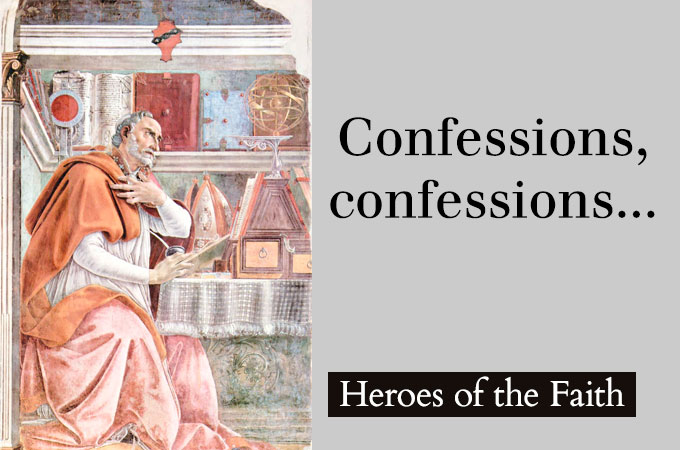
By the time he wrote his Confessions, Augustine seemed to have quite a lot to confess. The perfect example of someone who had been forgiven much loving much, this hero became the foundation of a lot of what we believe today.
Augustine, who later became Bishop of Hippo, is a unique character in the history of the Church, and one of almost unrivalled influence – at least in the West. His testimony, contained in his Confessions, offers an insight into the story of his soul with which we have no comparable account of any other ancient figure.
Augustine’s work on the Trinity remains foundational for our understanding of that doctrine and his characterisation of the Christian life as one of rightly ordered desire remains as fresh today as when he first wrote it – over 1,600 years ago.
What makes Augustine’s enduring influence remarkable is that his first devotion was to pleasure seeking. Having been born into a Christian family in North Africa in 354 AD, the infant Augustine was baptised as his life hung in the balance in the grip of disease. Up until the age of 16 he continued in the faith of his youth, but the age-old cocktail of sex, alcohol and licentious living defeated the teenage prodigy when he was sent away to Carthage. Before long he was a father – much to his chagrin!
But this was only the start of a tortuous journey back to God. In about the same year as he fathered a son (373) Augustine became enamoured with the teaching of Manichaeism – a Gnostic heresy. The passionate abandonment with which Augustine had pursued pleasure was now fixated on this new philosophy, which viewed the world in coarse, dualistic terms. In this, crime and evil became the work of an evil god and individual responsibility was accordingly eroded. Augustine saw Manichaeism as far more philosophically astute than the stories he had learned from the Old Testament and it was only when he fortuitously came across Bishop Ambrose in Milan having taken a teaching job there that Augustine was forced to reconsider his faith again. For the first time, he came across a Christian who commanded his intellectual respect. Nonetheless, he flirted with Plato before converting to Christianity for good, and that dalliance marked much of his later work after he became the Bishop of Hippo and began a prolific writing career.
Whatever Augustine’s changing views in his pilgrimage, he had a penchant for throwing himself headlong into whatever he found to do. There was nothing half-hearted in what he did. In fact, his initial fall into hedonism was preceded by a period of intense prayer.
After this period (in which he found himself unable to convince himself that he was being heard) Augustine abandoned all that he had known and sought pleasure with all the intensity he had previously prayed with. Although the pursuit of temporary pleasure at the expense of all else can hardly be praised, it does illustrate that Augustine’s life was always marked with intense desire.
His own deeply compelling account of the Christian life is one marked by the same intense desire. Even as he declares his dismay over his sinfulness, he suggests that he was merely obsessed with the wrong object. Augustine creates a distinction between cupiditas – loving a pleasure as an end in itself – and caritas – loving everything in relation to the ultimate love of God.
This incredible ability to learn from his most shameful experience is part of what endears me to Augustine; but his willingness to plumb depths unbefitting of a saint in public is another. What honesty he exhibits in painting a filthy image of himself as the chief of sinners! Bear in mind that this work was written when he was a prominent Christian leader and the transparency becomes all the more laudable.
Augustine carries plenty of overtones of Paul, in fact. Not only did his conversion represent a dramatic experience of grace, but Augustine was also a powerful, deep and influential thinker.
One of the things that I love about him is that his thought has been so foundational in Western Christianity and culture that people continually revisit his ideas and bring out new gems.
Augustine gave us our most popular accounts of original sin – though he is a lot less scathing of sex than you might imagine – and fought Pelagianism in defence of the tension between predestination and free will. He thought deeply and we stand in his debt. Oh, and he actually wrote the first recorded list of the books of the Bible in the Western Christian tradition.
More than just thinking through some of the issues of his time, though, he gave us language to speak about God that has stood the test of time. Augustine’s account of the Trinity still stands head and shoulders above many more modern attempts to understand that difficult doctrine. Augustine’s ancient interpretation of God’s great mysteriousness has been widely accepted and still forms a large part of the discussion today.
The thing that I most admire about Augustine, though, has to be the way in which he married his enormous intellect with the passion that marked his early misdemeanours. His contribution to Christian wisdom can barely be overestimated, and for that we owe him a debt of gratitude. But what makes Augustine special is that his writings invite us into the inside of his relationship with God. Where many thinkers become dry and dusty as they seek to define their philosophical ideals, Augustine’s work hums with the resonance of love.