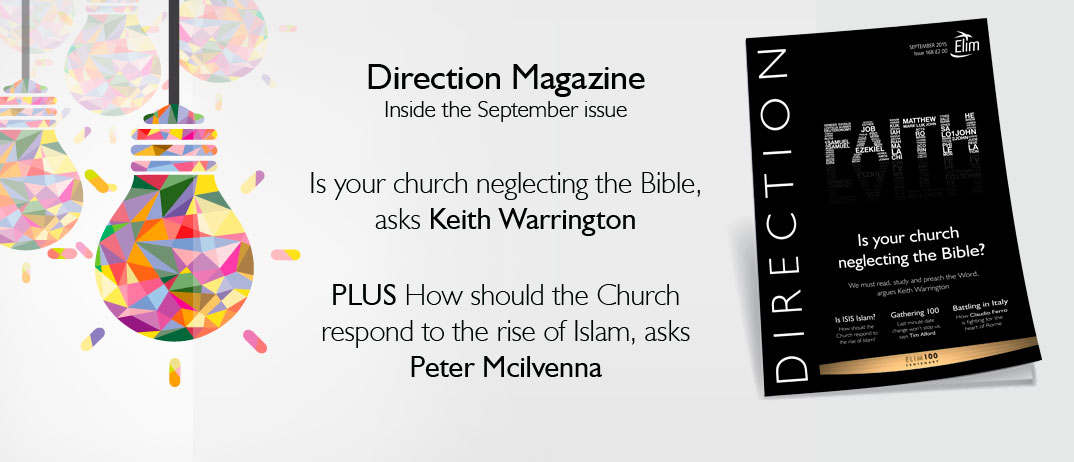
[vc_row][vc_column width=”1/1″][td_text_with_title custom_title=”What\’s inside the September 2015 issue of Direction Magazine…”] [/td_text_with_title][/vc_column][/vc_row][vc_row][vc_column width=”1/3″][vc_column_text]
EDITORIAL John Glass and all that jazz…

My parents bought me my first electric guitar when I was in my teens. Though I have not owned one for many years, I have no doubt that I could still play a decent ‘twelve bar blues’ – the chord sequence around which much rock and blues music is based – if called upon to do so.
I enjoy listening to Jazz, but the problem with that idiom is that, at one end of the spectrum, there is a point where almost no melody at all is recognisable. It’s at that point that I have to part company with the genre.
Perhaps the finest jazz drummer in the UK is the award-winning percussionist Troy Miller. Troy is not only a Christian but has spent most of his 40 years worshipping in Elim churches. When you listen to his album ‘40 Days’ you will need to be a jazz aficionado to appreciate some of the improvisations but, because he was classically trained at the Guildhall School of Music, he is also adept at writing arrangements for the Prague Philharmonic Orchestra.
In other words, what to the uninitiated may sound like random chords, rhythm and tones is in fact structured, and improvisation is only possible because, at the root of everything, there are the classical disciplines of musical arrangement.
I am totally in favour of fresh expressions of church. In our centenary’s ‘Big Centenary Ask’, I called upon our Movement to be constantly looking for new ways of doing church, both in content and form… and many of our churches are engaged in that. However, as in jazz, improvisation is only viable if there is a structure at the core, from which the rest is built.
We are now in the latter part of our centenary year in which we have been reflecting on the initial mission of our Movement’s founder George Jeffreys. Although the way his crusades were conducted – in tents rather than church buildings, or boxing arenas if the venues could be secured – there was always at the heart of what he did a theological ‘riff’ or chord structure. It was not a ‘twelve bar blues’ but a ‘foursquare gospel’ that declared Jesus as the saviour of the soul, healer of the body, baptiser in the Holy Spirit and the one who would one day return to earth at the second advent.
The New Testament gives very little instruction about forms of worship or structure of church. The Holy Spirit knew the need for a flexibility that was necessary if those forms reflected and flowed comfortably within cultures and the passing of centuries.
Doctrine, however, does need an irreducible minimum if it is to remain credible. Improvisation, if by that we mean ‘everybody doing whatever seems right in their own eyes’ is not a viable option.
Improvisation and subjective interpretations of a document as small as the highway code would lead to huge casualties and massive traffic incidents. The Scriptures, however, embrace eternal rather than temporal consequences. It allows for variations around some secondary issues, as outlined in Romans 14 but, when it comes to the essentials of the gospel, presents a narrow way.
A canvas by Piet Mondrian depicting a few basic geometrical shapes sold earlier this year for over $50 million. One is left wondering if the artist could have produced something with the technical intricacies of a Renoir or a Constable. In other words, before delving into the abstract, was there a grasp of that which was concrete?
The greatest jazz musician must first learn his scales and the most progressive writer her alphabet. Similarly, theology and ecclesiology, in its attempt to improvise and be relevant, should never deviate from God’s irreducible minimum.
CAN WE TALK ABOUT ISLAM? Islam is on the rise and the Church has to respond, argues Peter Mcilvenna
NEWS from Elim and the wider church
OUT AND ABOUT WITH THE GS John Glass opens his diary
WE CAN’T NEGLECT THE BIBLE Reading the Word of God is becoming marginalised, warns Keith Warrington
WHY WE NEED CHURCH UNITY Reaching out is good, but reaching out together is better, argues John Lacy
‘I AM PROOF THAT GOD HEALS’ Antonio Carvalho says God is watching over him after being healed several times

WORKING BETTER TOGETHER God was present throughout Aspire’s
residential weekend, reports Marilyn Glass
PRAY FOR ZANZIBAR’S CHRISTIANS Missionary John Bullock updates us on spreading the gospel on the archipelago
CHRISTIAN FOSTERING & ADOPTION Ministry very much starts at home for Kevin and Hazel Hornsby
NEW DATE FOR GATHERING 100 We won’t let a last-minute change of date stop us, says Tim Alford
BRINGING THE KINGDOM TO ITALY Claudio Ferro is fighting principalities and powers to spread the gospel in Rome
A PROBLEM WE CAN’T IGNORE The battle over pornography has only just begun, writes Lyndon Bowring

GET EQUIPPED FOR YOUR JOURNEY Dave Newton catches up with one man helped by Elim to answer the call of God
MUSIC REVIEWS with Ian Yates
MY BATTLE WITH DEPRESSION Sports star Leon McKenzie says God has been with him every step of the way
BE THOU MY VISION, O LORD We tend to shrink Jesus to the level of our own experience, explains Gary Gibbs
BREAKING ICE OVER BREAKFAST Mark Lyndon-Jones looks at how one church is welcoming unchurched men
BOOKCASE with Richard Dodge
ANSWERS withRajinder Buxton
AND FINALLY with John Lancaster

My parents bought me my first electric guitar when I was in my teens. Though I have not owned one for many years, I have no doubt that I could still play a decent ‘twelve bar blues’ – the chord sequence around which much rock and blues music is based – if called upon to do so.
I enjoy listening to Jazz, but the problem with that idiom is that, at one end of the spectrum, there is a point where almost no melody at all is recognisable. It’s at that point that I have to part company with the genre.
Perhaps the finest jazz drummer in the UK is the award-winning percussionist Troy Miller. Troy is not only a Christian but has spent most of his 40 years worshipping in Elim churches. When you listen to his album ‘40 Days’ you will need to be a jazz aficionado to appreciate some of the improvisations but, because he was classically trained at the Guildhall School of Music, he is also adept at writing arrangements for the Prague Philharmonic Orchestra.
In other words, what to the uninitiated may sound like random chords, rhythm and tones is in fact structured, and improvisation is only possible because, at the root of everything, there are the classical disciplines of musical arrangement.
I am totally in favour of fresh expressions of church. In our centenary’s ‘Big Centenary Ask’, I called upon our Movement to be constantly looking for new ways of doing church, both in content and form… and many of our churches are engaged in that. However, as in jazz, improvisation is only viable if there is a structure at the core, from which the rest is built.
We are now in the latter part of our centenary year in which we have been reflecting on the initial mission of our Movement’s founder George Jeffreys. Although the way his crusades were conducted – in tents rather than church buildings, or boxing arenas if the venues could be secured – there was always at the heart of what he did a theological ‘riff’ or chord structure. It was not a ‘twelve bar blues’ but a ‘foursquare gospel’ that declared Jesus as the saviour of the soul, healer of the body, baptiser in the Holy Spirit and the one who would one day return to earth at the second advent.
The New Testament gives very little instruction about forms of worship or structure of church. The Holy Spirit knew the need for a flexibility that was necessary if those forms reflected and flowed comfortably within cultures and the passing of centuries.
Doctrine, however, does need an irreducible minimum if it is to remain credible. Improvisation, if by that we mean ‘everybody doing whatever seems right in their own eyes’ is not a viable option.
Improvisation and subjective interpretations of a document as small as the highway code would lead to huge casualties and massive traffic incidents. The Scriptures, however, embrace eternal rather than temporal consequences. It allows for variations around some secondary issues, as outlined in Romans 14 but, when it comes to the essentials of the gospel, presents a narrow way.
A canvas by Piet Mondrian depicting a few basic geometrical shapes sold earlier this year for over $50 million. One is left wondering if the artist could have produced something with the technical intricacies of a Renoir or a Constable. In other words, before delving into the abstract, was there a grasp of that which was concrete?
The greatest jazz musician must first learn his scales and the most progressive writer her alphabet. Similarly, theology and ecclesiology, in its attempt to improvise and be relevant, should never deviate from God’s irreducible minimum.
John Glass
General Superintendent
Elim Pentecostal Churches
Direction Magazine
About | Print | Digital | Articles | Advertise | Mailing list