
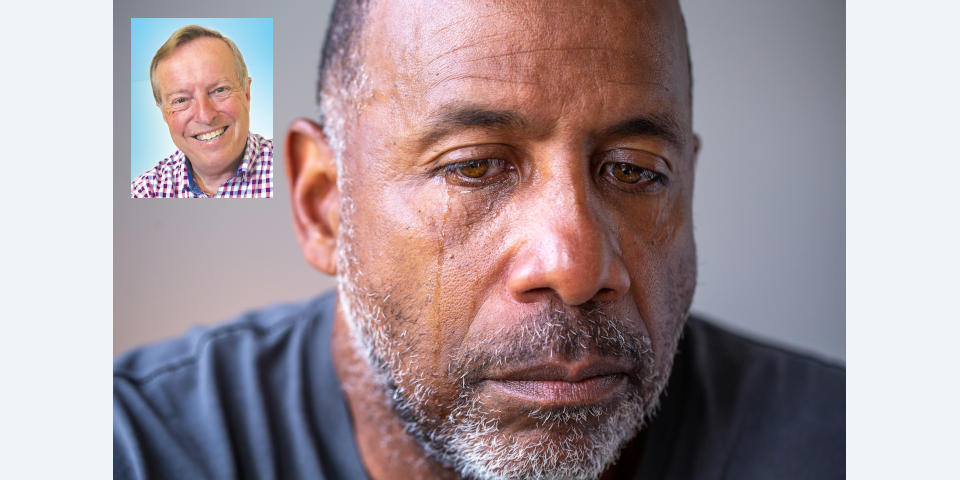
Eric Gaudion, inset, presents a compelling case in the defence of men's tears.,,,
If tears are a sign of weakness, asks Eric Gaudion, then why does God pay so much attention to them?
Recently, I was reading the searingly honest account of a dear friend’s battle with breast cancer and recovery, her gruelling chemotherapy followed by devastating surgery, when suddenly I could no longer see the page. The onrush of tears surprised me, but it should not have done; it happens a lot these days.
Since passing through the trauma of decades enduring some of the worst pain known to humanity, and long periods of hospitalisation with radical surgeries, I have rediscovered my tear ducts. I say this reluctantly because men are not supposed to cry. And I know why. From early on in life, boys are told that real men do not cry. The problem is that when they are older, they may stuff their feelings deep inside and withdraw emotionally from their loved ones, or self-medicate with alcohol or drugs, or even become suicidal.
Many men therefore need to learn the skill of reconnecting with their emotions. As a Christian, I have to ask – if these little facial droplets are a sign of weakness or defeat, how come God pays them so much attention?
When Jewish people sit down to engage with their annual Passover feast, it serves to remind them of the tears they shed during the 430 years of their captivity in Egypt. They take a little salt water and dip herbs in it, drinking the fairly repulsive brew as a sharp memorial to a troubled period in their race’s history. Yet, their tears played a big part in their eventual freedom. When God called Moses to deliver his people, he said that he had been moved by their crying due to their sufferings as slaves and intended to set them free. Tears became a down-payment on liberty. Tiny drops of salty water secreted from their facial glands actually changed their lives. History was transformed by a few hot droplets squeezed from suffering faces by oppression and desperation.
The Bible says that God collects our tears in his bottle (Psalm 56:8 in some versions) which means that he records our distress. The mighty King David, heroic leader of ancient Israel, wasn’t ashamed to soak his pillow with tears at night, (Psalm 6:6), both Isaiah and Jeremiah wept freely due to the sinful conditions of their day, and the great apostle Paul often preached through his tears (Acts 20:31).
But the greatest justification for men to weep is the shortest verse in the Bible – ‘Jesus wept’ (Jn 11:35). If the Son of God made use of his tear ducts so freely, then why do ours remain sealed in their newly minted ‘men don’t cry’ wrappers?
Since passing through those tough years of pain I find myself deeply moved by other people’s suffering. My tears flow when I read certain biographies or see hard scenes from Ukraine or Somalia on TV. Sometimes my breath is caught by reminders of some of the horrors I experienced in the Intensive Care Units that I describe in my book Through the Storms, and tears come unbidden, especially at night. I often wake to a soaked pillow.
This is all part of dealing with post-traumatic shock disorder (PTSD), but there is no need to fear or to suppress such tears. God made our tear ducts to enable us to wash out our emotions and distress, and alert others at times to our vulnerability. This is not weakness but part of our created humanity – a gift from a weeping God.
So, if you are holding back tears, perhaps even now, please know that there is one who cares. He wept at the tomb of his friend Lazarus, and then went on to raise him up. Grief is certainly a process that touches our tear ducts as much as every part of us and must be allowed to do so. What matters is not that your face is wet, but that your heart is open.
When we weep, our physical vision may be blurred but our spiritual perception can actually be heightened. So, why should we be ashamed of our tears?
Eric Gaudion is a retired Elim minister and author of five books, the latest being ‘Through the Storms; a manual for when life hurts’ (Instant Apostle Publishers, 2020). Read more online at www.ericgaudion.blogspot.com
From Direction Magazine 244


