
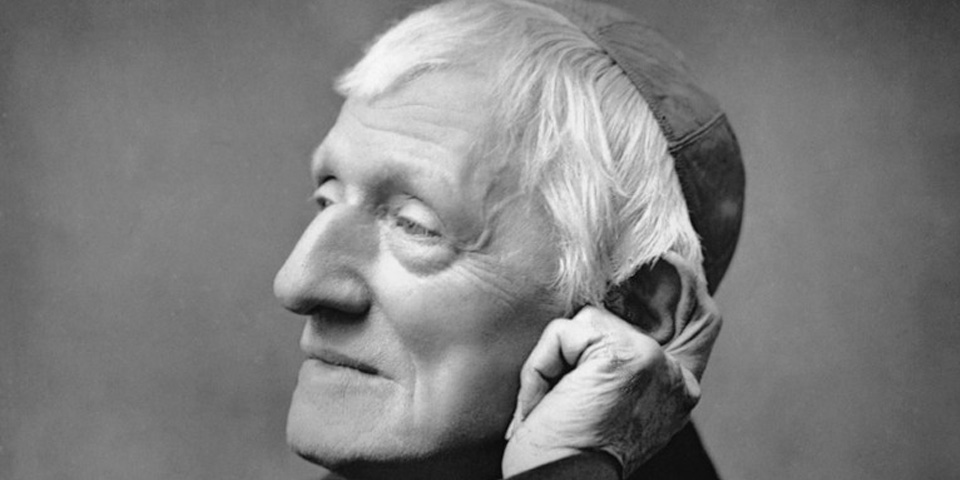
Hymn writer John Newman's most famous words should make us reflect,,,
In a recent TV survey of Christian music, the hymn ‘Praise to the Holiest in the Height’ was adjudged one of the most popular. Its well-crafted words and the lovely tune which accompanies it has evoked universal delight lasting to this present day.
Its author, John Henry Newman, was brought up in an evangelical home but after graduating from Oxford and becoming an Anglican minister he left to join the Roman Catholic church, becoming a highly respected cardinal in his later years.
In many ways the hymn reflects the changing theological perceptions of its author. It begins with a stirring vision of the exalted holiness and wisdom of God and moves in the next verse to a celebration of the redeeming work of the Lord Jesus Christ, but after that it meanders like a sluggish stream of thought which ends in a disappointing anti-climax. The cross is no longer seen as a victory over the powers of darkness (apparently Newman no longer believed in the doctrine of justification by faith) but as a lesson in sacrificial living: the agony of Jesus in Gethsemane and his death on the cross are there to ‘teach his brethren how to suffer and to die’. Even his fellow cardinal, Bernard Manning, rather harshly dismissed it as ‘humanitarian tinkling’, but many evangelical theologians also see it as a mistaken attempt to explain the wonder of the mystery of Calvary.
The fact that such a flawed hymn should gain so much popularity should give us pause for thought. Real worship is not just achieved by enjoying some nicely written words sung to catchy tunes; it is the outcome of a thoughtful response to the truths of God’s Word – it is a response to revelation, not rhythm. So songwriters, worship leaders and musicians, along with congregations, need to ask not only, ‘does it sound good?’ but ‘is it really true?’
Having said that, let us return again to the second verse of Cardinal Newman’s hymn:
“O loving wisdom of our God, when all was sin and shame,
A second Adam to the fight, and to the rescue came.”
The lovely words are an echo of Paul’s words in 1 Corinthians 17:45-49 in which he compares Adam, the first human being whose sin plunged the human race into disaster, with the second Adam, the ‘man from heaven’, who came to rescue the race from the tyranny of Satan and sin. That reminds me of the dramatic moment when a slender, teenaged shepherd walked down into the valley of Elah to confront the boastful Goliath, slew him and so rescued a trembling nation from his threats.
RESCUE
It also reminds me of that even more dramatic moment when a thirty-something carpenter from Nazareth bravely walked down into the valley of death to make atonement for the world’s sin, triumph over the ’Prince of Darkness’, and rescue a fallen world from the oppression of the ‘dark domain’ of satanic control.
If only Newman had followed his surging stream of thought to its logical conclusion! The cross of Calvary was not simply a classroom where moralism was taught, but a bloodstained battlefield where the ‘young Prince of Glory’, as Isaac Watts called him, descended from his heavenly home into ‘a world of woe’ to rescue a fallen race and re-establish the Kingdom of God on earth. “Preach the cross as victory,” cried Professor James Stewart in his book on Preaching, “it is for you to show the cross as it truly is – Christ in action, victor over death, vanquisher of the demons, going forth conquering and to conquer.”
In the same way, let us make sure that what we sing focuses not on ourselves but on the biblical truths about the exalted holiness of God and the glory of Jesus Christ our Redeemer.
From Direction Magazine issue 231.


