
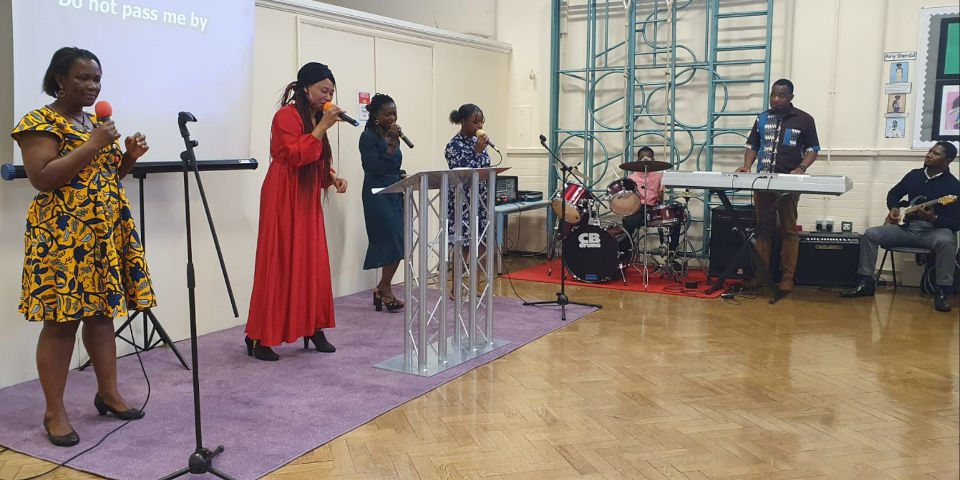
A service at Elim Rehoboth, Penge, in south London, a 2019 church plant now with thousands watching online.,,,
As Elim celebrated its centenary in 2015, every church was given a challenge: could you consider planting something fresh?
For several, the answer was to plant new churches. It’s a move which has accelerated Elim’s growth and contributed to 23 new Alliance churches, 20 pioneer projects and several branch churches being birthed in the past decade.
For Reach director Gary Gibbs, this centenary challenge was what spurred him to take up the baton for church planting.
“We’ve seen new churches started. We’ve also worked with some that needed repurposing,” he says.
Giving an example, he points to one of Elim’s biggest projects in decades: Life City Church in Wolverhampton, which Gary has helped lead.
“It’s the largest city in the UK where Elim didn’t have a church, but we’ve now got a building in the city centre next to the bus and train stations and we’ve seen the congregation double to 50 since we began during lockdown.
“It’s going really well. We’ve seen new people becoming followers of Jesus and a number of healing miracles, some of which have been astonishing.”
At the other end of the scale is a little plant in Mablethorpe on the east coast of England – Overboard Elim Church.
“Stacy and Phil Gibb, the couple who kicked that off, are doing great stuff there and have seen some amazing things happen.”
Here, he adds, one of the good things is that Stacy and Phil are not ordained ministers.
“They’re just really good folk who are having a go for Jesus. One of the challenges we face in Elim is helping people realise you don’t have to be ordained to plant a church. With a heart, vision and ability you can do it, and we’ll help you.”
With these and other flourishing plants up and running, Gary’s question now is what church planting should look like post-pandemic.
He is realistic: churches looking to pioneer plants today face three challenging opportunities.
‘CONSUMER CHRISTIANITY’
“Most congregations have regathered, on average, 60%-70% of their congregations.
“This seems to be because many people are saying, ‘We’re done with the big production thing on a Sunday with the big band, the lights and smoke machines.’
“So one issue to address is the fact we got into consumer Christianity before lockdown.”
Life City Church seems to be addressing this well, he says.
“Typically on a Sunday morning we’ve got one guy and his guitar or keyboard leading us in a couple of songs, then we preach, then serve coffee and cakes.
“Some people say they like this simple, peeled-back version of worship.”
A second opportunity is a greater focus on discipleship.
“A lot of pastors are realising we didn’t do this well pre-pandemic, but just gathered people and measured success by counting numbers,” says Gary.
It’s an issue he addressed in the book he published during lockdown, Discipleship Lifestyle.
“I ask how we make disciples, and do those disciples develop other disciples? If we do this, eventually we’ll get a critical mass of people who are followers of Jesus gathered together, and that’s a church.”
The third opportunity is responding to the spiritual hunger of a largely unchurched population.
“Many people are questioning what life’s all about, and non-Christians are making big decisions after the pandemic because they realise life is pretty empty.
“It’s a great opportunity. But it’s not easy because we’re dealing with people who are second, third, fourth generation removed from church, so you have a missionary situation.
“We’ve got to equip Christians to share their faith in their workplaces and communities so they can ‘go and tell’, then invite people to ‘come and see’.”
As the year progresses, Gary says Elim needs to review its church plants and be realistic about which are flourishing and which are not.
But he also expects to see an increasing regional focus on planting which will help accelerate growth.
“My role in the next few years will be to work alongside Elim’s regional teams and identify, train and release people into planting.
“If they take up the baton for church planting, we’ve got more opportunity and potential for multiplication and that’s an exciting way forward for Elim.”
Felix Appiah, Elim Rehoboth, Penge, south London
In September 2019 I started a church plant in my house. It grew as people invited their friends. Families were coming all the way from Basingstoke because they love how we’re a family and they belong here – we value their presence and who they are, irrespective of nationality or ethnicity.
We were growing, so in March 2020 we managed to find a new place to meet, but then lockdown came. I’d always said I wasn’t going to go on social media but with lockdown I was wondering what to do. We’d just started a church – how could I sustain that? So I put our services on Facebook Live. The first week we had about 300 people watching, then it grew to over 1,000, and now we have 5,000-10,000.
God has done tremendous miracles in the church. Recently, we were praying for a woman of 25 who had cancer, for example. We’ve never met her but we prayed and she has been given the all-clear.
Every Christian needs to be encouraged to walk into their full potential, so we invite our church members to help lead our weekday prayer meetings.
We’re also reaching out to our community and other towns nearby. I go to care homes to conduct services, leading them in singing and leading them to Christ.
Looking ahead, we want a permanent home because there are so many more things we want to do for the community. We have teachers who want to help kids prepare for their GCSE and A-levels, for example, but because we don’t have a place, it’s a challenge.
As we’ve been growing the church, I’m really thankful for several people who have been very helpful: David Campbell, Gary Gibbs, Geoff Blease, Filden Adjei, Alfred Asiedu and Joel McGuinness. I’m really grateful for their support.
From Direction Magazine issue 234


