
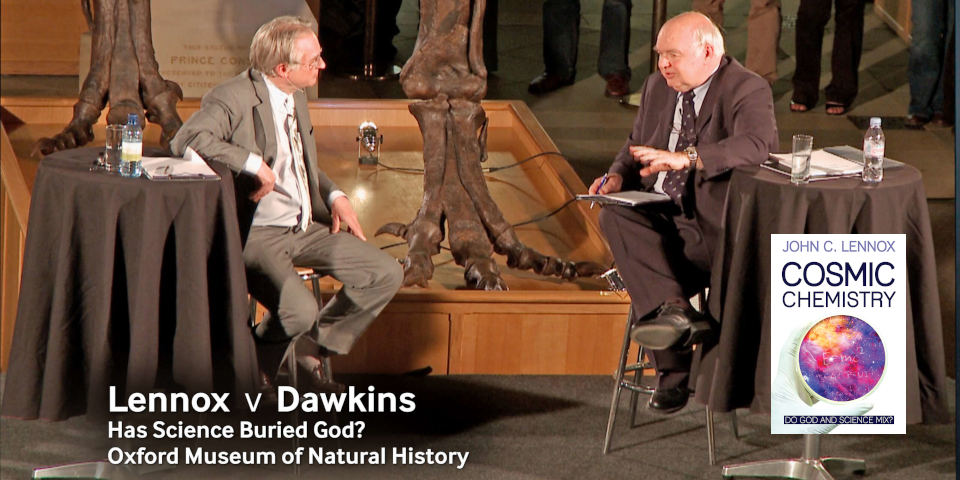
Towards the end of the 20th century, a group styled the ‘New Atheists’ led a concerted attack on religion, singling out Christianity in particular. One of the leaders, Richard Dawkins, declared that, “When one person suffers from a delusion it is called insanity. When many people suffer from delusion, it is called religion.”
Although many of his fellow atheists were unhappy with his aggressively militant tone, it was Dawkins’ view that predictably hit the headlines in the media, especially when he claimed these opinions were based on ‘scientific’ reasoning: “Scientific belief is based on publicly checkable evidence, religious faith not only lacks evidence; its independence from evidence is its joy, shouted from the rooftops,” he stated.
In other words, according to Dawkins, all religious faith could be summed up as ‘blind’ faith.
One person (among many) who took exception to Dawkins’ statements (and indeed debated him in public) was Professor John Lennox, so it is good to welcome Lennox’s thoughts in his new book, ‘Cosmic Chemistry’. From the beginning, Lennox takes issue with Dawkins’ misconceptions concerning faith, showing that – at least as far as biblical Christianity is concerned – faith has its eyes wide open.
For thinking Christians like John Lennox, evidence lies at the heart of the faith. As he says, “faith, as presented in the New Testament, is a considered response to evidence, not a rejoicing in its absence… It is no part of the biblical view that things should be believed where there is no evidence. Just as in science, faith, reason, and evidence belong together.”
Dawkins’ view of faith as ‘blind faith’, therefore, turns out to be, according to Lennox, “the exact opposite of the biblical one.”
It is unfortunate, therefore, that Dawkins’ definition of faith has become popularised, as, “no serious biblical scholar or thinker would support [it]” So Lennox asks, “could it be as a consequence of blind faith of his [i.e. Dawkins’] own?”
Lennox is certainly not alone among scientists who think this way. Francis Collins, former Head of the Human Genome Project and current Director of the National Institutes of Health (NIH) said of Dawkins’ postulate that it “certainly does not describe the faith of most serious believers in history, nor of most of those in my personal acquaintance.”
Indeed, as Lennox himself comments, “it shows that those who reject all faith as blind are destroying their own credibility.” As one white crow is enough to destroy the notion that all crows are black, so the existence of countless believers who take their faith seriously enough to study the evidence behind it torpedoes the simplistic arguments of the new atheists that all faith is blind.
However, having said that faith is evidence-based, just what evidence should we examine? There is, of course, the evidence of the design and order of creation, which Paul tells us that God has left as a witness to his ‘his eternal power and divine nature.’ (Rom 1:20) Rather than science disproving God, as the new atheists claim, it is rather a witness to the presence of a great designer. As Sir Gillian Prance, FRS, former director of London’s Kew Gardens said, “For many years I have believed that God is the great designer being behind all nature… all my studies in science since have confirmed my faith. I regard the Bible as my principal source of authority.”
PIONEERS
Of course such a view is merely reflective of the thinking of the early pioneers of modern science such as Bacon, Galileo, Kepler, Newton and Clerk Maxwell. They believed that the starting point for science was a intelligible universe made by a rational creator. Therefore, as Kepler said, scientists were merely “thinking God’s thoughts after him.”
Even the incredible mind-bending complexities of the universe discovered by recent advances in science surely do not point us away from a great designer but towards one. As Sir John Houghton, FRS, former director of the British Meteorological Office, wrote: “The remarkable order, consistency, reliability and fascinating complexity found in the scientific description of the universe are reflections of the order, consistency, reliability and complexity of God’s activity.”
The other evidence which Lennox points us towards is historical – that presented in the New Testament in the life and work of Jesus Christ.
“In his biography of Jesus, the Christian apostle John clearly expresses this point: ‘these things are written that you might believe …’ That is, he understands, that the collection of supernatural signs that he recalls Jesus as having performed (we often call them ‘miracles’) form evidence on which faith can be based. That is, faith that Jesus is God incarnate is evidence-based.”
Of course, there is vastly more evidence that Professor Lennox presents during the course of this entertaining and intellectually challenging book. The thing he leaves us with is that the Christian faith can stand up to any amount of reasoning. In fact, it is our very God-given reason that leads us to the realities of faith rather than the opposite. As Lennox says, “Dawkins’ idiosyncratic definition of faith provides a striking example of the very thing he claims to abhor – thinking that is not evidence-based. In an exhibition of breathtaking inconsistency, evidence is the very thing he himself fails to supply for his claim that independence of evidence is faith’s joy. And the reason why he fails to supply such evidence is not hard to find – there is none!”
‘Cosmic Chemistry’ by John Lennox is published by Lion.
John Lennox MA PhD DPhil DSc is Emeritus Professor of Mathematics at the University of Oxford and Emeritus Fellow in Mathematics and Philosophy of Science at Green Templeton College.


