
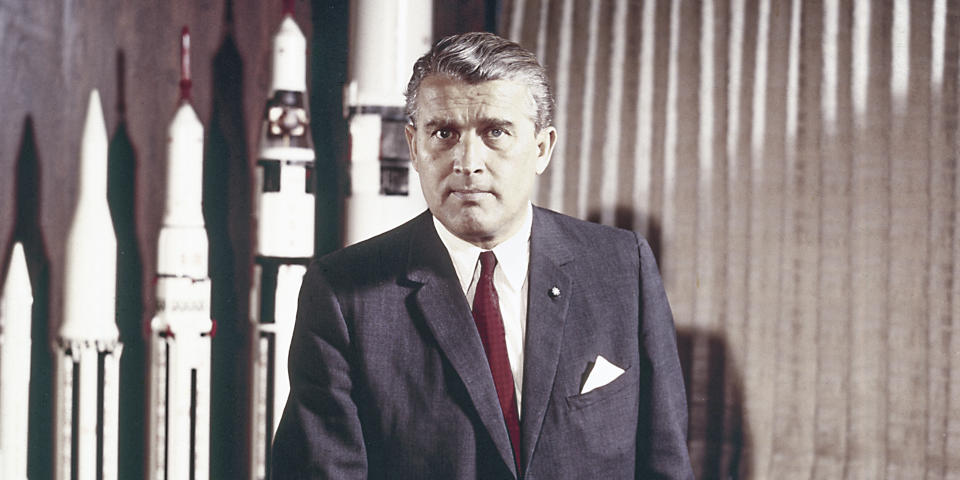
Wernher von Braun sent Apollo 11 on its way with a prayer.,,,
A new mission will land the first humans in more than half a century on the moon – inspired by the 1969 “giant leap for mankind” that had a controversial Christian at its core.
The third phase of NASA’s Artemis project is expected to land the first woman and person of colour on the moon in 2025, bringing back grainy memories of Neil Armstrong’s “small step”.
At the Apollo 11 launch before Armstrong planted those first footsteps into the moondust, though, the scientist leading humanity’s most astronomical advance turned to the oldest, highest power of all as he gave the final “Yes” for blast-off.
Wernher von Braun, head of the Apollo Applications Program and director of the US Space and Rocket Center, did it so calmly that it only emerged later when he was asked by a reporter what he was thinking as Apollo headed toward history. He answered: “I quietly said the Lord’s prayer.”
With a nation’s hopes on his shoulders, von Braun relied on God throughout the high-pressure missions, revealing: “I certainly prayed a lot before and during the crucial Apollo flights.”
A man of faith, clearly, but that hadn’t always been the case for someone born in 1912 and raised as a nominal Lutheran in the small town of Wirsitz, in what’s now Poland.
There was still no sign of knowing God when he studied mechanical engineering at the University of Berlin and graduated with a PhD in physics in 1932.
The same year, before the Nazis came to power, the German army asked him to sponsor a team working on rocket development, launching von Braun into a leading role in the world’s foremost rocketry programme.
With Hitler about to seize power, it thrust the scientist into controversy, as the Nazis made rocketry a priority. Von Braun masterminded the first successful launch of an A-4 rocket, which became known as the V-2. The rocket later wreaked havoc in London in September 1944, when it was blamed for more than 9,000 deaths.
Von Braun’s role in the V-2’s reign of terror has never been clear, but it was reported he at first refused to work with the Nazis, saying he “did not intend the A-4 to be a weapon of war, that he had only space travel in mind … and that he regretted its military use.”
What is clear is that von Braun was then arrested and held for two weeks, with his life only spared when the head of the Gestapo was persuaded he was “absolutely essential” to the rocketry programme.
Despite the horrific London death figures, more slave labour victims died building the V-2 rockets than were killed by it as a weapon.
Von Braun admitted visiting the V-2 plant at Mittelwerk on many occasions, calling it “repulsive”, but claiming never to have personally witnessed any deaths or beatings, although it was clear to him by 1944 that deaths had occurred. He denied ever visiting the Mittelbau-Dora concentration camp which supplied the plant’s workers, and where 20,000 died.
DARING
Von Braun escaped both the SS and the Russians in a daring escape at the end of the war, leading 500 people through battle-torn Germany to surrender to the Americans, who offered him immigration.
During the 1950s, the US military had a rocket development initiative, and von Braun became the country’s leading rocket scientist, even appearing with Walt Disney in a 1955 show on manned space travel.
Russia’s 1957 launching of the satellite Sputnik 1 into orbit prompted the US authorities to choose von Braun to lead the nation’s effort for an orbital launch vehicle.
Von Braun had originally proposed such an idea in 1954, but it was turned down. But from that idea came the Mercury-Redstone rockets that put a man in space, and then the Saturn rockets for the Apollo programme.
It was during the Apollo efforts that von Braun’s colleagues began to notice “a new element … in his conversations … speeches and writings: a growing interest in religious thought.”
In truth, it was an interest that had been brewing for years, since he first entered the US and visited a church in Texas in 1946.
Von Braun recalled: “A neighbour called and asked if I would like to go to church with him. I accepted, because I wanted to see if the American church was just a country club as I’d been led to expect.
“Instead, I found a small, white-frame building in the hot Texas sun. Together, these people make a live, vibrant community. This was the first time I really understood that religion was not a cathedral inherited from the past, or a quick prayer at the last minute. To be effective, a religion has to be backed up by discipline and effort.”
That experience planted the seed that bloomed years later. Fellow engineer Albert Wilson gave von Braun a Gideon Bible and, over the next seven years when the chance arose at the Marshall Space Flight Center in Huntsville, Wilson would ask von Braun if he had any Bible questions.
Eventually, on a Saturday morning in about 1962, von Braun called Wilson to his office and prayed the sinner’s prayer, word for word from the back of the Gideon Bible. After the “Amen”, von Braun said he felt like a huge weight had been lifted from his shoulders.
As witnessed at that historic 1969 Apollo moment, von Braun relied on prayer from then on.
He joined a congregation and, before his death from kidney cancer in 1977, began to speak publicly about his faith in God and how it complemented his knowledge of science.
As von Braun explained: “Through science man strives to learn more of the mysteries of creation. Through religion he seeks to know the Creator. Science and religion are sisters. Both seek a better world.”


