
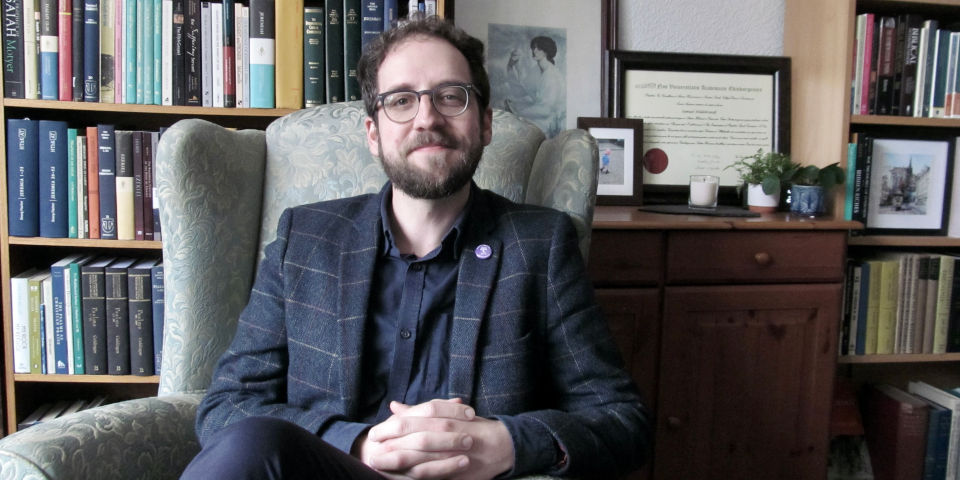
Samuel Hildebrandt has been studying the Bible's take on loneliness, with interesting results.,,,
Last year, Bible scholar Samuel Hildebrandt helped Limitless leaders understand more about loneliness. Here, he tells Direction about his research.
Loneliness, by its very nature, is a very personal matter. Most people can recall periods where they felt particularly alone. This may be in their teenage years or when moving to a new city.
When Samuel Hildebrandt, a lecturer in Biblical Studies at Nazarene Theological College, began his research on loneliness, an exchange to Canada during his BA studies stood out.
“For the first time in my life,” he says, “I was separated from my family and friends and the first few months were quite challenging.”
The struggle of being alone has reached a new dimension during the pandemic with millions suffering the emotional, physical and mental effects of isolation.
In his research, Samuel has discovered some stark statistics.
Among them, the Jo Cox Commission on Loneliness revealed more than 14 per cent of Britain’s population often or always felt lonely. The Office of National Statistics found that 16 to 25-year-olds report feeling lonely more than people aged 65-74. And a report by the UK Mental Health Foundation showed how lockdowns, shielding and social distancing had aggravated loneliness, with 25 per cent of UK adults reporting being lonely in November 2020, up from 10 per cent in March 2020.
“Loneliness, silently and swiftly, is becoming the new mainstream,” Samuel says.
So much so, he adds, that the UK appointed a minister for loneliness and launched the Let’s Talk Loneliness campaign to support older people in 2019. Annual reports on loneliness are now produced too.
Surprisingly, loneliness is rapidly rising among young people.
“Everyone’s on social media and that can actually alienate us even more. You feel more alone because you look at other people’s posts and no one seems to be alone,” says Samuel.
Research shows how destructive loneliness can be from a biological perspective.
“There’s something in our brain that responds to it like a threat. There are a lot of correlations between chronic loneliness and medical conditions like heart disease and sleep problems.”
WHAT DOES THE BIBLE SAY ABOUT LONELINESS?
Firstly, Samuel says, the Bible recognises the threat of loneliness. Take Genesis 2:18, for example, where amid the magnificence of creation, God says it’s ‘not good’ for Adam to be alone.
Secondly, the narratives and poems in the Bible show how common and complex loneliness is. Jeremiah, for instance, experienced isolation when he distanced himself from his sinful peers (Jeremiah 15); elsewhere, people experience loneliness as part of God’s judgment or restoration (Lamentations 1, for example).
Beyond these Old Testament examples, Jesus cried out from the cross when he felt abandoned by his father.
“That Jesus expressed that he felt abandoned shows just how important it is to cultivate a language for loneliness and to remove the stigma of being alone. Feeling lonely and needing to talk about it doesn’t make you a failure or a bad Christian. It’s a normal part of being human,” says Samuel.
Samuel points to Psalm 102 as a special example of the Bible’s focus on loneliness. After setting a scene of mental and physical distress, verses 6-7 say:
“I am like a desert owl, like an owl among the ruins. I lie awake; I have become like a bird alone on a roof.”
The roof setting is important, he says, because roofs in Old Testament times were often places to socialise, sleep and worship.
“The roof is an ideal place for portraying the full pain of loneliness. At the very moment the psalmist enters that place of human rhythms, company and worship, he realises just how lonely he is.”
Also interesting is the fact there are three birds mentioned, but one is really lonely.
“Even though there are other birds, that might sometimes make it worse – you can feel more lonely in a crowd.”
IMPACT
Psalm 102 also illustrates that loneliness can have a severe physical and mental impact.
“In the ancient world, loneliness and death are two sides of the same coin. Modern psychological analysis echoes the diagnosis of the psalm: social isolation is not just an undesirable state of existence, but rather a threat to existence.”
Bible verses may not themselves end loneliness, but they can help people become more comfortable with time spent alone.
“Very often, Christian responses to loneliness are along the lines of ‘Jesus will always be with you’. In other words, ‘You may feel alone, but you’re not’,” says Samuel.
“I’m not sure that’s helpful for a lot of people who still feel lonely because they are lonely.
“The Bible, though, seems to say loneliness is something everyone experiences; that we have to cope with it at certain times.”
Psalm 102, he concludes, can bring hope.
“The lonely bird can be the first step to articulating and acting upon our loneliness.
“This particular image holds within it the hope of a new-found freedom, of soaring again with the flock.”
“But this text is not only for the lonely: it calls all who read it to look beyond the edge of their nests and to notice the lonely birds that sit all around them.”
Samuel Hildebrandt’s work on loneliness will become available later this year in his study ‘I am a Lonely Bird. Psalm 102 and the Psychology of Loneliness’ (Biblical Theology Bulletin) and in 2023 in his scheduled book ‘Old Testament Poetry and the Language of Mental Health’ (Fortress Press). For more information, contact Samuel at shildebrandt@nazarene.ac.uk
From Direction Magazine issue 234


