
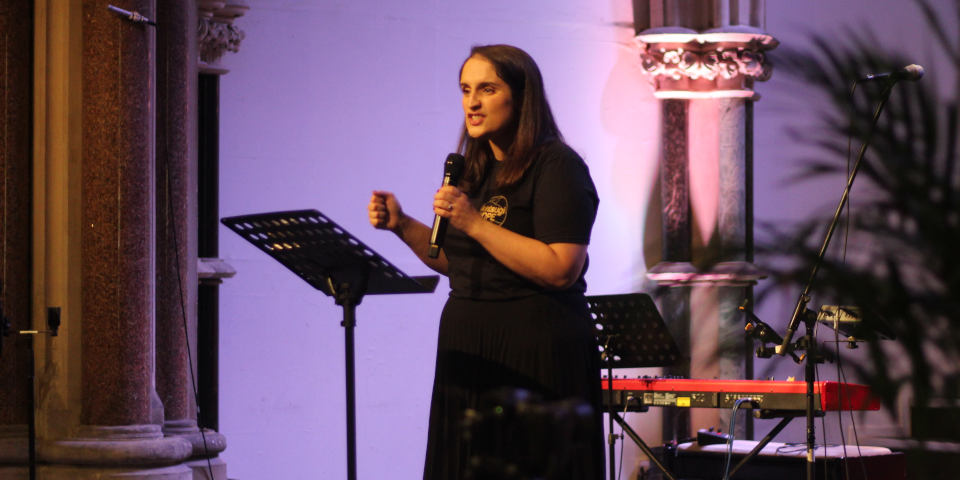
Rachael Newham (pictured above) of mental wellbeing charity Kintsugi Hope was stumped by a question raised in one Zoom gathering. Today she’s taking steps towards the answer.
“It’s great that Kintsugi Hope is creating safe and supportive spaces, but what happens when the church isn’t a safe and supportive space?”
It was one of those questions that made the whole (Zoom) room stop still. It was the summer of 2020 and we were all still relatively new to online meetings during the pandemic, but even on screen you could
see the impact the question was having.
We’d come together to talk about Kintsugi Hope’s wellbeing groups, which were starting all over the country as people sought to find places to explore their emotions and build connections with others. It was clear the groups were making an impact, but that question exposed how far we have to go in terms of ending the stigma of mental illness in our churches.
The conversation about mental health in our churches had certainly begun, but there was still much to say and much to change. The crux of the making our churches safe and supportive for those exploring their mental health emerged as the conversation continued. It’s an issue of theology because, try as we might, our churches cannot be safe until we get to grips with a theology of mental health and mental illness, to understand what Scripture has to say about our emotions and how best we should care for one another.
So, as 2020 rumbled on, the idea for the Mental Health Friendly Church Project emerged, becoming a reality the following year. And one of the first tasks was the understand the landscape of attitudes towards mental health in the UK church.
The coronavirus pandemic had changed everyone’s lives and we wanted an accurate picture of what those attitudes were so we could create resources that would really make an impact.
As the late Christian mental health campaigner and author Steve Austin wrote: “The journey of healing, whether for individuals or for whole church communities often starts with a reckoning; an honest assessment of the way things really are; not the way we wish they were.”
Along with Christian think tank Theos, we surveyed 1,000 regular churchgoers and 20 church leaders on their attitudes towards mental health within the UK church. The findings were a mixture of encouragements and challenges.
What quickly became clear was the need for consistent language around mental health, mental wellbeing, mental ill-health and mental illness. The terms are often used interchangeably, but they are best understood as points along a continuum.
CONTINUUM
We all have mental health in the same way we all have physical health – and one in four will experience a mental illness in any given year – but between these points are differing levels wellbeing and we all move along the continuum over the course of time.
For me personally, the greatest encouragement was that those we surveyed agreed wholeheartedly that UK churches could help those who are experiencing mental health issues. Indeed, historically the church has been at the forefront of mental health care. The oldest mental health hospital in the world, The Bethlehem Royal, is named after the birthplace of Christ, and many of the old asylums were started by monasteries and nuns.
The church has a rich history of caring for people’s minds, but somewhere along the passages of time, we’ve lost our way. The research reminded us to recapture and reimagine that mandate. It also highlighted a number of challenges, particularly the lack of training among church leaders, with 91 per cent receiving no mental health training either in ministerial training or since, so it’s unsurprising that 56 per cent of churchgoers said their churches rarely or never spoke about mental health.
Connected to this was the finding that only 35 per cent of respondents felt their church had been supportive of their mental health, and the church leaders we spoke to in particular felt that mental health issues are still stigmatised within the church.
Stigma can be defined as “a mark of disgrace associated with a particular circumstance, quality, or person” and in the case of mental illness in the church often relates to people being seen as if they are lacking in faith if they are struggling, or that their condition is the result of personal sin.
These beliefs impact the way in which people are able to relate to one another and the level to which they feel they can be open and honest about their struggles, when in fact, as Walter Bruegemann puts it: “Churches should be the most honest place in town, not necessarily the happiest place in town.”


