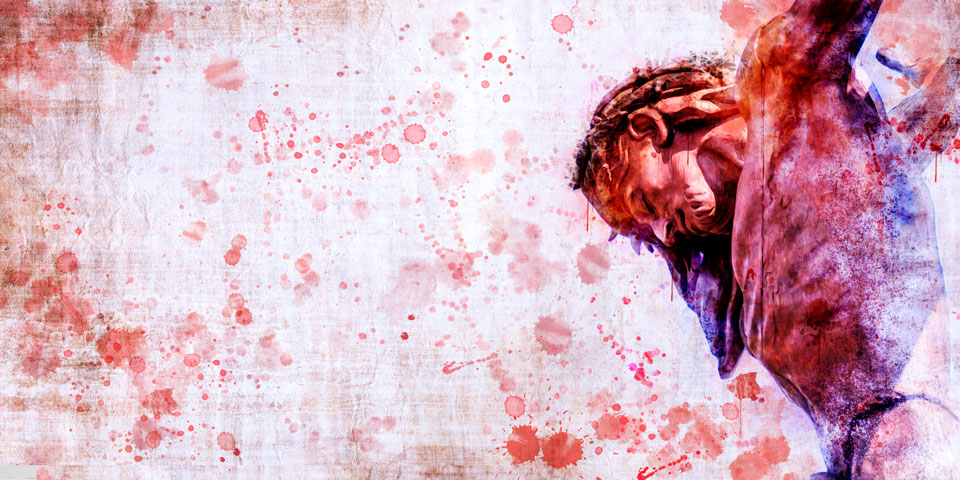
Whilst hanging on the cross, fighting for every breath, Jesus managed to speak out seven important sentences, which can form the basis of a really meaningful devotional study, says Phil Weaver
We can learn from what Jesus said on the cross.
“Father, forgive them, for they know not what they do.”
(Luke 23:34)
Jesus looks down from the cross, he sees the soldiers who mocked, scourged and tortured him, and who had just nailed him to the cross. He remembers those who have sentenced him – Annas and Caiaphas the High Priests, the Sanhedrin and Pontius Pilate.
He thinks of his disciples who had deserted him, Peter who had denied him three times. Below him is the fickle crowd who only days before praised him on his entrance to Jerusalem.
Could he also have been thinking of you and me, who at times somehow manage to forget, ignore or deliberately disobey him?
When Jesus uttered these eleven unforgettable words, he revealed a higher, greater type of love that this world had never seen before or indeed since – agape Love.
“Truly, I say to you, today you will be with me in Paradise.”
(Luke 23:43)
Jesus was crucified between two criminals, one of whom has the audacity to mock him.
But the criminal on the other side speaks up for Jesus, saying that he and the other criminal were receiving their just dues, whereas, ‘this man has done nothing wrong’. Then, turning to Jesus, he asks, “Jesus, remember me when you come into your kingdom,” (Luke 23:42).
Ignoring his own suffering, Jesus responds with mercy and grace. “Today,” Jesus says, “you will be with me in Paradise.
Such generosity, love and forgiveness to a man who only asked to be remembered!
Jesus said to his mother: “Woman, this is your son.” Then he said to the disciple: “This is your mother.”
(John 19:26-27)
What sorrow must have filled Mary’s heart! How must she have felt, seeing her son as he was flogged and as he attempted to carry his cross on the Via Dolorosa? And then, as she watched, her boy was nailed to the cross and hoisted into the air to die.
It must have felt like a sword piercing her very soul; and then she remembered the prophecy of Simeon at the presentation of the infant Jesus in the Temple some thirty-odd years before (see Luke 2:35)
From the cross, through his blurred and blood-stained eyes, Jesus sees his mother with John, one of the Twelve. “John,” he says, “make sure you look after my mum.” ‘Honour your mother and father...’ Exodus 20 commands us. Something Jesus never forgot – not even when he was about to draw his last breath on the cross!
[swpm_protected for="2-3-4" do_not_show_protected_msg="1"]
"My God, my God, why have you forsaken me?”
(Matthew 27:46 and Mark 15:34)
It is in the ninth hour, after three hours of supernatural darkness, that Jesus cries out this fourth statement. After this, the Gos-pel of Mark relates with a haunting sense of finality, “And Jesus uttered a loud cry, and breathed his last,” (Mark 15:37)
It is particularly striking to hear the tormented tone of this statement in contrast with the first three sentences. Jesus feels that the Father has deserted him. This is the agonising cry of the human Jesus. In this one sentence the loneliness of the Saviour is emphasised (Mark 15:40), and he must face death by himself.
The crowd believed he wasn’t the Christ because he didn’t come off the Cross and save himself. The Bible says the opposite: he is the Christ because he stayed on the cross to save us from our sins!
"I thirst.”
(John 19:28)
Jesus’ fifth statement is the shortest and the only one that is an expression of his physical suffering.
The wounds inflicted upon him in the scourging, the crowning with thorns, the loss of blood, his staggering walk up the Via Dolorosa to Golgotha, and the nailing upon the cross are now taking their toll. Is it any wonder he is parched?
Could it be, though, that there is more than physical thirst here? Jesus must have also thirsted in a spiritual sense. He thirsts for the love of his Father, who has left him unaided during this dreadful hour when he must fulfil his mission alone. And no doubt he thirsts for the love and salvation of his people, the human race.
"It is finished.”
(John 19:30)
Of all the statements that Jesus made on the cross this is by far the most poignant. And rather than it being an expression of defeat and failure, it is actually an expression of accomplishment. The Greek word translated ‘it is finished’ is ‘tetelestai’, an ac-counting term that means ‘paid in full’.
When Jesus uttered these words, he was declaring the debt owed to his Father caused by man’s disobedience was wiped away completely and forever. Not that Jesus owed the Father himself, rather he eliminated the debt owed by mankind – the debt caused by sin.
The work Jesus was sent to do was to ‘seek and save that which is lost’ (Luke 19:10), to provide atonement for the sins of all who would ever believe in him (Romans 3:23-25), and to reconcile sinful men to a holy God (2 Corinthians 5:18-19).
None other but God in the flesh could accomplish such a task.
"Father, into your hands I commend my spirit.”
(Luke 23:46)
The final statement Jesus made on the cross was directed to the Father in heaven. Just before he died, Jesus recalled Psalm 31:5 which says, “Into your hands I commend my spirit.”
To ‘commend’ means to entrust something precious to another’s care with great confidence. Jesus was literally entrusting his spirit into his own Father’s hands for protection as he was about to begin his journey through the valley of death.
Commending his spirit means he entrusted everything to the Father: Jesus knew that whatever happened in his death God the Father would have to preserve his spirit. Without him doing so Jesus would have remained dead.
[/swpm_protected]This article was taken from the Spring 2020 issue of iBelieve Magazine.
This isn't the end of the story!
To continue reading the full article, and to access all of the fantastic content available on our website, subscribe below!
Find Out More
This article is from iBelieve Magazine. Click below to find out more about the latest issue.
-

iBelieve Magazine Spring 2024
£4.00 – £120.00 Select options This product has multiple variants. The options may be chosen on the product page
Our Publications
To find out more about any of our publications, click the links below: