
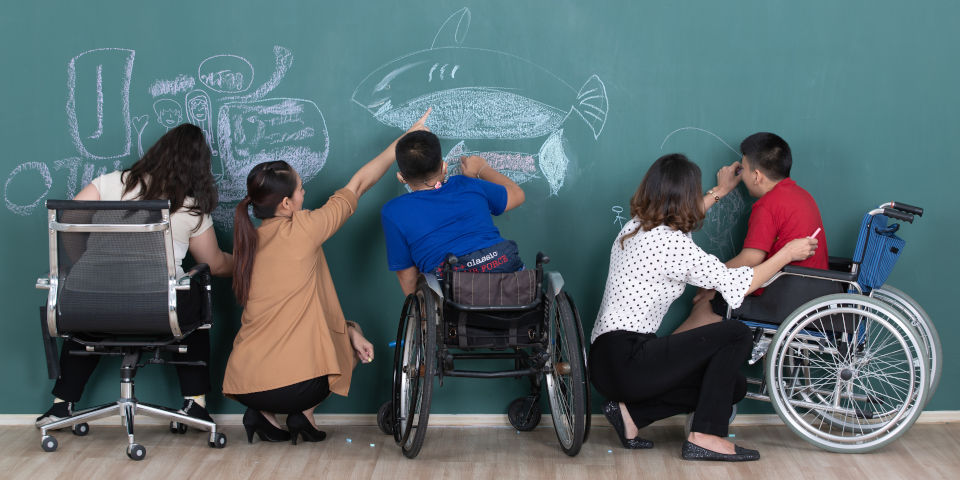
Improving the church experience for people with disabilities can be surprisingly simple.,,,
How can we make church accessible, welcoming and inclusive for young people with disabilities? From a recent Limitless podcast featuring Urban Saints’ Additional Needs Ministry Director Mark Arnold, we bring you eight key tips.
1 Treat people like Jesus did
Look at the many times in the gospels that Jesus encounters somebody who has a disability. Disabled people were and are important to Jesus and he taught us so much through those encounters.
Quite often, when we read stories of Jesus meeting a disabled person, the narrative in our head is: “Jesus meets disabled person. Jesus cures disabled person of their disability. Everybody moves on.” But that’s just scratching the surface. Often Jesus is teaching so much more about how to engage with disabled people, listen to them, how their faith and salvation is really important, and to see the entirety of the person.
2 Disabled people are not healing projects
In the story of Bartimaeus, Jesus has a blind man in front of him and you can imagine a big crowd gathered, expecting to see another amazing miracle.
But what Jesus does next is quite surprising and an enormously important teaching moment for us. He asks Bartimaeus a question: “What would you have me do for you?”
Jesus didn’t assume. I’m pretty sure he knew Bartimaeus was blind and I’m pretty sure he knew what Bartimaeus wanted from him. But he didn’t just go on in there, lay hands on him and pray. He gave Bartimaeus the respect and dignity to articulate for himself.
If we could learn that lesson from Jesus and ask those questions, that would be an important step forward.
3 We need to change
It’s us as youth workers who need to change and adapt what we do to meet the needs of disabled young people. We should never expect them to fit in or do the adapting themselves to meet our expectations and the way we do things.
There’s a phrase that goes around in the disability community: “Nothing about us without us.” It’s about journeying with people. It’s our role to hear from them, then with them change the things we’re doing. What we’ll find typically is those changes make what we do better for everyone.
4 Copy existing support
Explore ways in which these young people are supported and given the input they need in other areas of their lives.
Typically, young people will be in school, so what support is provided there to help them? What can we learn from an environment where they go for most of their day so that when they’re with us for an hour or two on a Sunday or on a club night we’re able to put those same support structures in place to help them.
This means we don’t have to reinvent the wheel – plus, it gives continuity for young people.
5 If you build it, they will come
There’s a line everyone remembers from the film Field of Dreams: “If you build it, he will come.” And that’s relevant here too.
We actually have a legal duty to get things right under the Equality Act, so it’s not good enough for us to wait until a disabled young person comes through the front door to then start thinking about how we can put things in place. We’ve got a duty to be ready for them so that when they arrive things are in place to support them.
Obviously, we can tweak things when somebody arrives, but make sure the basics are in place: can people get into the building? Can they move around it? If they go to use the disabled toilet will they find it’s been turned into a storage cupboard? Are there trip hazards? It’s about doing an audit of our space.
6 Remove barriers
What things do we do in our programme that could be barriers for young people? Are there tables that are too high for somebody using a wheelchair? What games do we play that exclude somebody who has a physical disability? How we could adapt those things so we’re ready for when a young person comes through our door with whatever disability, difference or diversity they may bring with them?
That’s the right way for us to be, but it’s also the best welcome we can give because they can see we’re not just reacting to them arriving, but we’re ready for them.
7 Level the playing field
There are loads of different ways young people can be involved and included in an activity.
If you’ve got a really active game and you’ve got somebody with a physical disability that affects their mobility, for example, you could see if they could be the referee, the scorer or the host of the activity. It’s also about looking for active games that actually level the playing field.
One of the highlights for me at the Paralympics is the sitting volleyball. It’s such a great game to play and of course, somebody with a mobility disability may well be able to take part and have a great time with their peers. It’s loads of fun, but it’s a real leveller and really inclusive.
8 Disabled adults can help
We can seek out disabled adults in our church communities and get them on board to help audit our buildings.
Ask them, “What are some of the areas that are barriers for you?” Not only does that give them the opportunity to help us as we think about this from a youth perspective, but it might help in a broader church context too.
From Direction Magazine issue 242


