
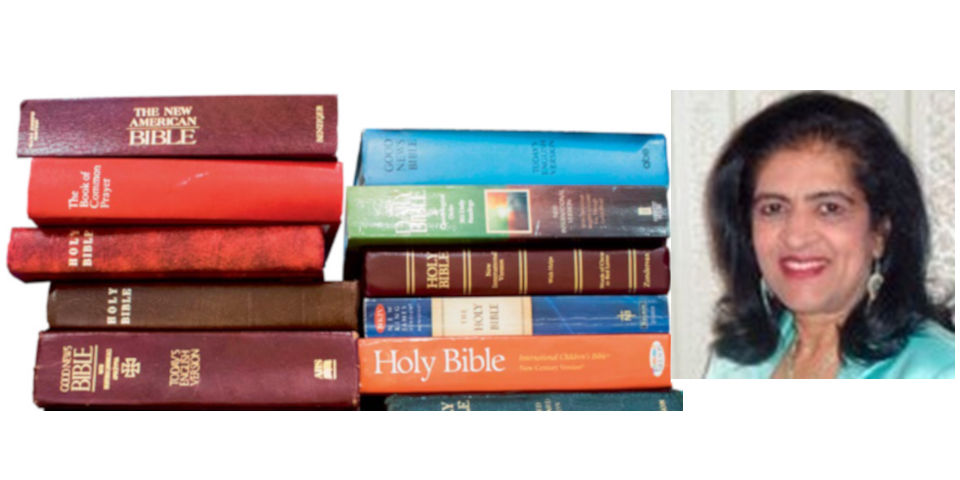
Rajinder Buxton, inset, of Ryde Elim Church's ministry team tackles some fundamental questions.,,,
You ask Elim experts the questions. This month, it’s Rajinder Buxton, a member of the ministry team at Ryde Elim Church, Isle of Wight.
What exactly are we asking for when we pray, “Give us this day our daily bread…”?
The prayer we call the ‘Lord’s Prayer’ is both one that we can pray as it stands and also it is a model Jesus showed us of how we can pray generally. So it begins, not with our requests to God but by our focusing on him as our God and Father. We start our prayers by acknowledging his greatness and utter holiness.
We pray for his kingdom to come to earth, which can happen in different ways including by individuals getting saved and receiving Jesus, the King, into their lives, when they begin to live by his kingdom values, and by praying for Jesus’ second coming, when he will set up his kingdom on earth.
Having focused on God who already knows our needs, the second part of the prayer is about our requests: our daily bread, forgiveness and protection.
In Jesus’ day, the common people would not have had much to live on. Often workers were paid daily and subsisted from day to day, and praying for food was a daily reality. For us, it would perhaps include all our necessities for day-to-day life/
Does it matter what translation of the Bible we use? Are some more accurate than others?
The Bible was originally written primarily in two languages – the Old Testament in Hebrew (with some short passages in Aramaic), and the New Testament in Greek. So when we read it in English, it is always a translation. And as anyone who speaks more than one language will know, many words or phrases have meanings that do not directly translate from one language to another.
What is important to realise is that English versions can perform different tasks. Some are actually paraphrases, where the purpose is not so much to give a word-for-word translation, but rather to phrase sentences and ideas in such a way that the meaning of the original passage is given for clarity of understanding. By contrast, other versions seek to be more literal translations, where the English closely reflects the original wording of the Hebrew and Greek.
Which is better? For an easy understanding of the ideas, choose a paraphrase. For serious Bible study, a more literal translation is required.
We learn in Ecclesiastes 3:11 that God set eternity in the human heart. What does that mean?
This is a clear reality we can see all over the world. No matter what ethnic origin or country, city or rural dwellers, even those in the remotest jungle, all people are the same. We are all created in the image of God and all are descended from the same two original human beings – Adam and Eve.
As such, each person has the stamp of the image of God upon them, even though humankind’s sinful nature has left that image severely tarnished. But it means that each person instinctively has within his or her heart, the knowledge that there is more to life than the short, physical time we spend on earth.
God has placed that knowledge there to give each person the opportunity to seek him and find him. Most people have some kind of hope or belief in the afterlife, as expressed, for example, through other religions, or New Age practices. Many respond to that intuitive knowledge in their heart, but look in all the wrong places.
Interestingly, the number of people claiming to be atheists was surprisingly small in the last UK census, even after 150 years in the West of constantly being bombarded with evolutionary teaching. Nothing can truly kill what God has put in a human’s heart.
From Direction Magazine issue 237


